Deflecting Tickets vs. Resolving Issues: The Quality Trap in AI Support
by Optimus AI Labs7 min read
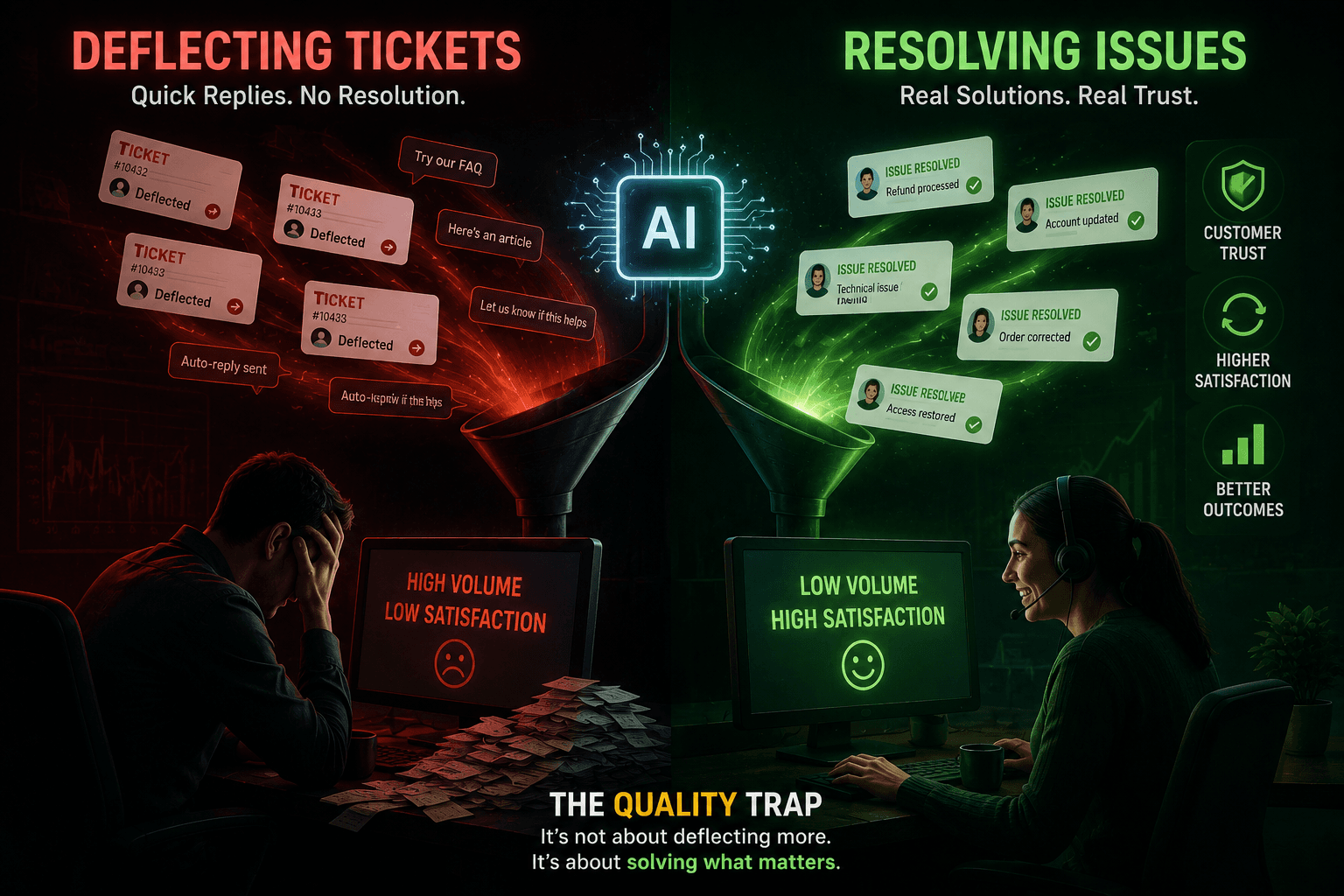
A support director at a pan-African insurance company showed her quarterly dashboard with real pride, with deflection rate up thirty per cent and average handle time down by nearly half.
Then she flipped to the next slide, the one she'd almost skipped, and the CSAT score told a completely different story. It had dropped six points over the same quarter, and cancellations were up. She stood there for a second before saying what everyone in the room was already thinking. The bot was closing tickets, but it wasn't fixing anything. This is the kind of problem that hides in plain sight because the numbers everyone's watching are the wrong numbers. What stuck with me about her presentation was the order of the slides. Deflection came first, celebrated on its own before anyone reached the CSAT number that told the real story. That ordering wasn't an accident but a show of which metric the team had been trained, quarter after quarter.
Why the Dashboard Lies to You
Deflection rate measures only one thing: whether a ticket got closed without a human touching it. It says nothing about whether the customer's actual problem got solved. A bot can deflect a ticket by giving a vague, technically not wrong answer that sends the customer away confused, and the system counts that as a win.
This is how a support team ends up celebrating a number that's actively working against them. Every deflected ticket that didn't resolve anything becomes a customer who's now more frustrated than when they started, because they spent five minutes typing their problem into a bot that gave them nothing useful, and now they still have to find a human to solve it properly. Except this time they're annoyed before the conversation even begins.
Executive teams that judge support AI purely on volume- how many tickets it closes, how many humans it kept out of the queue- are optimizing for a metric that can rise while the actual customer experience quietly falls apart underneath it.
Support leaders have to make the case, often against real resistance, that speed without resolution is just delayed frustration wearing a good quarterly report.
What Fast and Wrong Costs
When an AI tool gives a customer a fast but wrong answer, the ticket doesn't disappear but goes underground for a while. The customer tries the suggested fix, it doesn't work, and they come back angrier, now needing a human agent to untangle both the original problem and the bad advice that came before it. That second contact costs more than the first one would have, in agent time, in the customer's patience, and often in the customer's willingness to stick around at all. Preventing customer churn from bad AI chatbots means recognizing that a wrong answer isn't neutral. It's worse than no answer, because it burns trust and time before the real fix even starts. The boardroom version of this cost is straightforward once someone actually measures it. A support team can show falling ticket volume and rising deflection while customer lifetime value quietly erodes behind the scenes, because the customers who got a bad automated answer are the ones most likely to churn at renewal.
Measuring ROI on AI customer support only works if churn and repeat-contact rates sit right next to the deflection number, not off in a separate report nobody cross-references. A useful exercise for any support leader is pulling a sample of tickets the AI deflected last month and simply checking whether those same customers filed another ticket about the same issue within two weeks.
That single check tends to surface the gap between what the dashboard says and what actually happened, faster than any formal audit would.
Stop Letting the AI Guess
The single biggest driver of a wrong answer is a support AI that's improvising from general training instead of reading your actual policy.
Ask a general-purpose model about a refund window without grounding it in your company's real documentation, and it'll answer confidently anyway, because sounding confident is what it learned to do, whether or not the specific facts it's stating are true for your business. The fix is architectural, not a matter of writing better prompts. Connect the AI directly to your verified internal knowledge base, your actual product wiki, your real policy documents, and your historical ticket resolutions, and build the system so it answers only from what it retrieves there rather than from its own general memory.
This is what grounding actually means in practice. The AI isn't reasoning about what your refund policy probably is. It's reading the current version and repeating it accurately. Improving first-contact resolution with AI depends almost entirely on this discipline. A support bot that can cite the specific policy line it's drawing from, and that refuses to answer when it can't find one, will resolve fewer edge cases outright, but the ones it does resolve will actually be correct.
That trade is almost always worth making, because a smaller number of genuinely right answers builds more trust than a larger number of confident guesses.
Handing Off Before The Customer Gives Up
There's a specific kind of damage that happens when a frustrated customer gets stuck fighting through a bot loop that clearly isn't going to help them. By the time they finally reach a human, their irritation has grown well past the original issue. They're annoyed about the ten minutes the bot just wasted too. The fix is teaching the AI to recognize its own limits before the customer has to point them out. Certain signals should trigger an immediate, seamless handoff to a human agent: repeated frustration in the customer's language, a technical issue that falls outside the AI's grounded knowledge, or an account flagged as high value where a wrong answer carries outsized risk.
The handoff itself matters as much as the timing. A customer who gets bounced to a human with no context, forced to re-explain everything from scratch, experiences that as almost as much friction as never escalating at all. A well-built handoff carries the full conversation history and the AI's own assessment of what it couldn't resolve straight into the human agent's queue. The customer notices the difference immediately. Instead of starting over, they're picking up a conversation that already has some context behind it, which reads as competence rather than another dead end. Getting this handoff right takes real coordination between whoever built the AI system and whoever manages the human support team, since the two groups often work off separate tools and separate incentives.
Treating the handoff as a shared responsibility, with both sides accountable for how smoothly it goes, tends to produce a far better customer experience than leaving it as an afterthought bolted onto the AI's error handling.
The Metrics That Tell The Truth
Support leadership needs a different scorecard than the one most teams inherited from an earlier, volume-obsessed era of automation. Ticket deflection rate, on its own, rewards a team for making tickets disappear regardless of whether the underlying problem went with them. First-contact resolution is the metric worth centering instead, because it measures whether the customer's issue actually got solved in that first interaction, human or AI, rather than just moved out of the queue. Pair it with customer effort score, which captures how much work the customer had to do to get their answer, since a technically resolved ticket that took three frustrating attempts still represents a real cost to the relationship.
Enterprise AI support metrics for leaders should also track repeat contact rate specifically for AI-handled tickets, since a customer coming back within a day or two about the same issue is the clearest possible signal that the first answer didn't actually work. For illustrative purposes only, a support team that shifts its core KPI from deflection rate to first-contact resolution often sees deflection numbers dip in the short term, simply because the AI is now willing to admit when it can't solve something.
That dip usually reverses within a couple of quarters, once the grounded knowledge base and smarter escalation logic start doing their job properly, and the resolution numbers that replace it tend to be far more durable.
What Leadership Should Actually Be Asking
A strategic C-suite guide to AI customer experience conversations must always circle back to one uncomfortable, necessary question at the next quarterly review: Is our automation actually solving customer problems, or is it simply hiding them somewhere less visible until they resurface as a cancellation? Deflecting a ticket is easy; resolving an issue is where true customer loyalty is earned. At OptimusAI Labs, we engineered eeV precisely to bridge this gap. As an AI-powered software development company, our eeV platform transforms customer support by shifting the focus entirely from superficial deflection to genuine, end-to-end resolution.
The Resolution-First Advantage
A customer service automation strategy built around resolution rather than vanity metrics demands more of your technology, your knowledge base, and your support leaders. eeV delivers that higher standard by integrating deeply into your systems to execute real fixes on the first try. When your AI is powered by eeV, it does what automation was always meant to do:
- It integrates seamlessly with your backend workflows so issues are actually resolved, not just closed out.
- It eliminates the friction that forces customers to fight for a real answer.
- It bypasses endless chat loops and gets straight to the root of the problem.
That is the version of automation your customers will actually notice and appreciate. Stop settling for automated deflection that masks underlying churn. With eeV by OptimusAI Labs, you can deploy intelligent support solutions that drive true first-contact resolution and turn customer service into your brand's greatest retention engine.