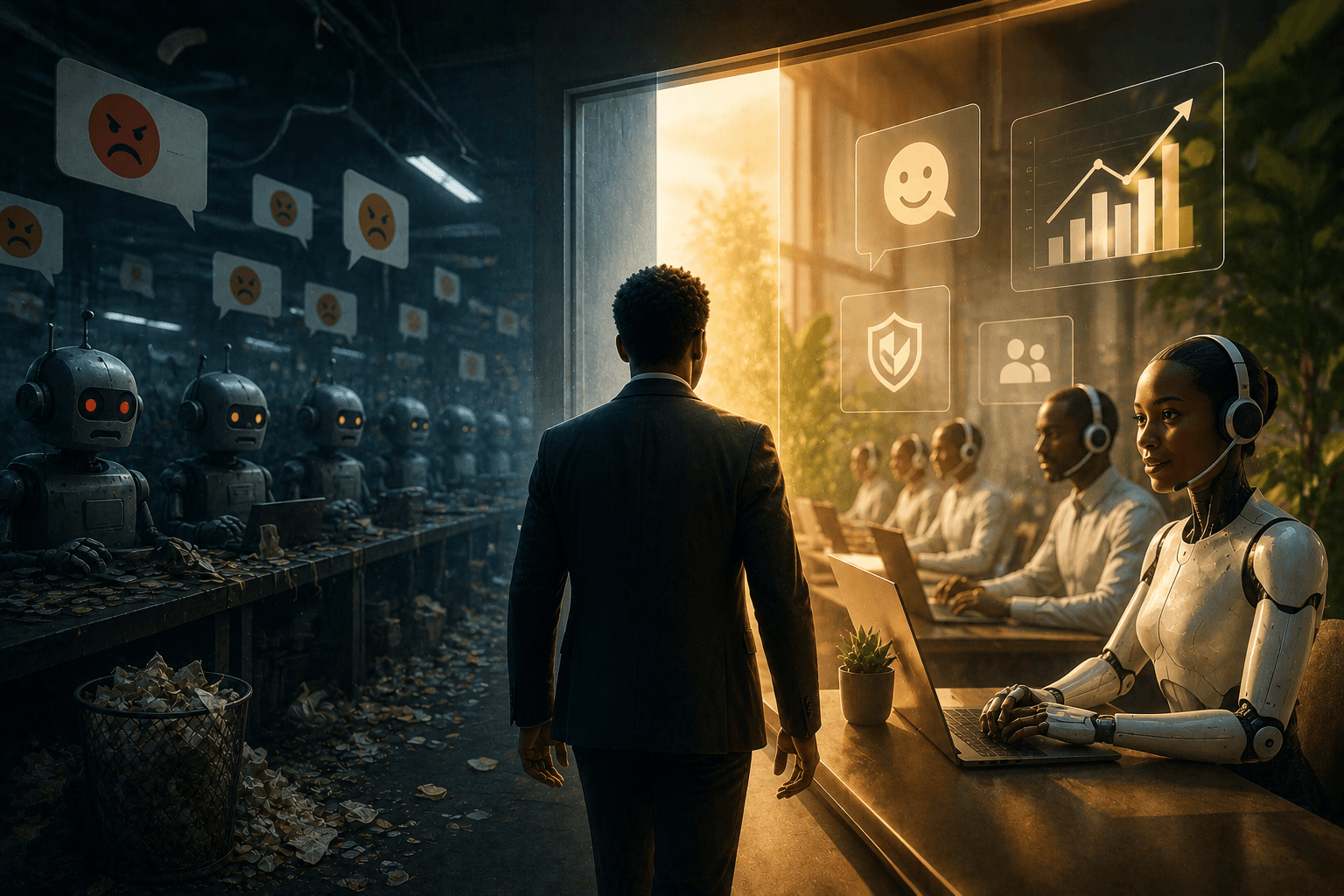
Overcoming the Scam Fear: How AI Helps New Nigerian Brands Win Instant Customer Trust
by Optimus AI Labs6 min read

A jewellery seller in Port Harcourt once watched forty-three people add her new gold-plated pieces to cart in a single week. Four of them actually paid. She spent days convinced her prices were wrong or her product photos weren't good enough, until a friend finally told her the truth nobody wants to hear about a brand-new store.
The product wasn't the problem as the store was three weeks old, had no reviews, and looked exactly like a dozen fake stores that had scammed people that same month. Her visitors weren't rejecting her jewellery; they were protecting themselves from a risk that had nothing to do with her personally and everything to do with being unknown.
That gap between interest and payment is where a huge number of new Nigerian online businesses quietly die, and almost none of them realize the real cause until it's too late. What struck her most, once she understood it, was how personal she'd taken the rejection. She'd read every abandoned cart as a verdict on her taste, her pricing, her photography. None of that was actually being judged. Her visitors were running a much simpler calculation in the background, one that had nothing to do with the jewellery itself: is this a real store, and can I trust it with my money right now?
Why the cart gets abandoned right before checkout
Someone lands on your store, likes what they see, adds it to their cart, and then just leaves at the exact moment they'd need to type in their card details or send a transfer. That specific pattern, interest followed by a sudden stop right before payment, is rarely about the product or the price. It's the moment the brain switches from browsing mode into risk mode, and for a store the shopper has never heard of, that switch flips hard. Every unfamiliar element on a new store's checkout page becomes a reason to pause. No visible reviews, no sign the seller actually ships what they promise, no easy way to ask a quick question before committing real money. The shopper isn't being difficult. They're doing exactly what anyone would do before handing money to a stranger, which is looking for a reason to trust before they act, and if that reason doesn't show up fast, they close the tab and try a brand they've already heard of.
What hesitation actually costs a new business
Here's the part that kills promising new stores before they ever get a fair shot. Every abandoned cart isn't a neutral, forgettable event. It's money already spent on ads or social media reach that produced a visitor genuinely interested enough to add something to cart, and then lost anyway, right at the final step. Building buyer trust for new online stores matters because low trust doesn't just cost you individual sales, it inflates the actual cost of every customer you eventually do win.
When conversion rates stay low because shoppers don't trust a brand-new store, a merchant ends up paying for far more traffic than they need to hit their sales target, which makes customer acquisition expensive enough to threaten the whole business before it gets a chance to build the track record that would have solved the problem naturally. The cruelest part of this cycle is how invisible it stays to the merchant living through it. Ad spend looks like it's working, because traffic and interest both show up clearly in the dashboard.
What doesn't show up as clearly is exactly where and why that traffic fails to convert, so a lot of struggling new stores spend even more on ads trying to fix a problem that was never about reach in the first place.
Answering doubts before the shopper leaves
A shopper with a real question- does this run true to size, how long will delivery actually take, what happens if I need to return it- wants an answer right now, not tomorrow morning. If that question sits unanswered for hours, the shopper doesn't wait patiently. They assume the worst and go somewhere else, often within minutes. AI customer engagement for Nigerian SMEs solves exactly this gap. A conversational assistant trained specifically on your actual policies, your real delivery timelines, and your genuine return process, can answer a hesitant shopper's question instantly, at eleven at night, on a weekend, whenever the doubt actually shows up.
This isn't about replacing a human agent with a robot that sounds like one. It's about making sure a shopper's question never sits there long enough for suspicion to take over, because in that gap between question and answer is exactly where a sale quietly dies. The response also has to actually help rather than merely arrive quickly. A generic, scripted reply that dodges the real question raises suspicion just as fast as silence does. The assistant needs to answer with specifics pulled from your actual policies, because a vague answer to a specific worry reads as evasive, and evasive is exactly what a scam looks like from the outside.
Borrowing trust from people who've already bought
New stores face an honest disadvantage here. Established brands have hundreds of reviews built up over years. A three-week-old store has almost none, and a handful of reviews looks thin and unconvincing next to a competitor with thousands. Overcoming customer skepticism in e-commerce doesn't require waiting years to accumulate that same volume. It requires surfacing whatever real proof you do have at the exact moment a shopper needs to see it. A live notification showing a delivery that just completed successfully in the shopper's own city carries more weight than a static testimonial buried on an about page nobody visits.
A verified review that speaks directly to the shopper's specific hesitation, sizing accuracy for a clothing store, delivery speed for a food business, lands harder than a generic five-star rating with no context attached. Intelligent curation tools can pull the most relevant piece of proof and place it right where doubt peaks, at the checkout page itself, rather than hoping a shopper scrolls back to a reviews section they've already skipped past. Reducing cart abandonment from trust issues often comes down to this single tactic, showing the right proof at the right second rather than burying good evidence somewhere the anxious shopper never looks.
The anxious wait between payment and delivery
Getting someone to actually pay is only half the trust problem. The anxiety doesn't end at checkout. For a lot of first-time buyers, the period between paying and receiving the product is the most stressful part of the entire transaction, because that's exactly when a scam would become obvious, if it were one. Silence during that window reads as confirmation of the shopper's worst fear, even when nothing has actually gone wrong. A buyer who paid and hasn't heard anything in two days starts imagining the seller has disappeared with their money, even if the order is sitting perfectly fine in a delivery queue.
Automated, real-time updates sent straight to WhatsApp or SMS close that gap before panic sets in. A message confirming the order was packed. A message when it leaves for delivery. A message when the rider is nearby. Each one is a small, specific proof that the transaction is real and moving forward exactly as promised. This kind of communication costs the merchant almost nothing to run once it's set up, and it does more to prevent a nervous buyer from calling their bank to reverse the payment than any amount of customer service charm applied after the fact.
I think this window gets underestimated precisely because nothing is actually wrong during it. The product is genuinely on its way. The seller genuinely intends to deliver. But intention doesn't reassure a buyer who's already been burned once by someone else, and only visible, specific proof does that job.
What to Actually Change on Your Storefront
E-commerce customer experience optimization for a new store starts with a short list of concrete, checkable changes rather than a vague commitment to being more trustworthy.
Put a live chat assistant on every page, not buried three clicks deep in a help menu nobody finds. Display real delivery confirmations and specific reviews directly on the product and checkout pages, not tucked away on a separate testimonials tab.
Set up automated order status messages that fire the moment something actually changes rather than leaving a buyer checking their phone and finding nothing. Boosting e-commerce conversion rates for a brand-new store isn't really about spending more on advertising to compensate for a leaky checkout.
It's about closing that leak directly, at the exact moments doubt naturally shows up, so the traffic you're already paying for actually converts instead of quietly disappearing at the final step. At OptimusAI Labs, we engineered Nexa to solve this exact challenge. As an AI-powered software development company, our Nexa platform serves as the intelligent commerce layer connecting buyers and merchants, turning a leaky storefront into a high-converting engine of trust. Just like the jewellery seller in Port Harcourt who integrated real-time communication and updates into her workflows, your business can eliminate the hesitation that kills sales. Her conversion rate didn't triple overnight, but the shoppers who used to vanish right before payment started actually completing their orders; because for the first time, her storefront was intelligent enough to answer their doubt before it had the chance to win. Stop letting buyer hesitation drain your ad spend and stall your growth. With Nexa by OptimusAI Labs, you get an intelligent commerce layer that connects your buyers and merchants, answers doubts in real time, and turns casual visitors into confident, paying customers.