How AI Can Make Existing ERPs Smarter Without Rebuilding Them
by Optimus AI Labs6 min read

A manufacturing company in Ghana had been running the same ERP system for eleven years. It knew the business inside out: supplier relationships, seasonal inventory patterns, production timelines, every warehouse transaction since the company's second year of operation.
Then a consultant told the board they needed to scrap it and migrate to a new AI-native platform. The migration quote came in at $2.3 million and eighteen months of implementation time, with no guarantee the institutional knowledge buried in the old system would survive the transfer.
The board said no; their IT lead said there was another way.
The assumption that AI requires a clean, modern foundation is one of the most expensive misconceptions in enterprise technology right now.
Legacy ERP systems are not obstacles to AI adoption. They're assets, provided you know how to connect intelligence to them without touching what's already working.
Why Replacement Is Usually the Wrong Call
Enterprise ERP systems accumulate value over time in ways that aren't visible on a sheet. A decade of transaction history encodes how your business actually behaves: which suppliers deliver on time, which product lines move in which seasons, which cost centres consistently run over budget and why. That knowledge lives in the database, not in the software version.
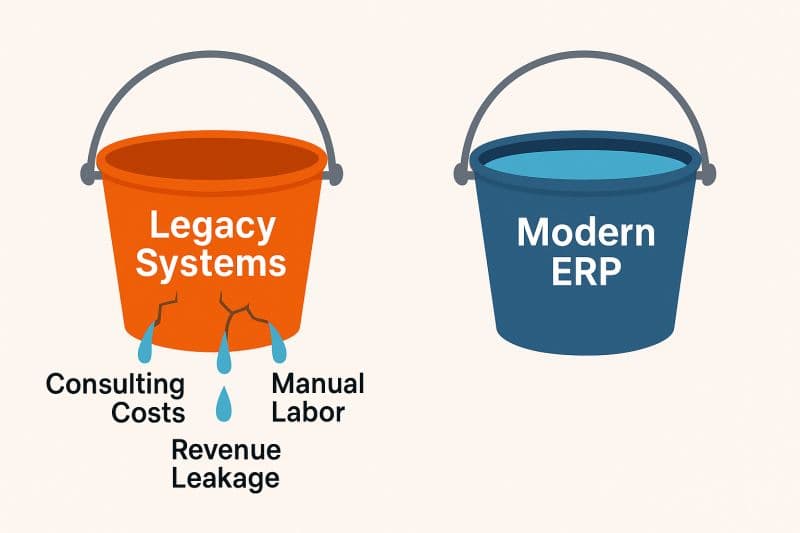
Replacing an ERP doesn't migrate that knowledge. It migrates data, which is a different thing. The business logic, the edge-case handling, the customizations built over years of adapting the system to how real work actually gets done, these rarely survive a full migration intact.
What companies often discover after a rip-and-replace project is that they've spent millions to rebuild, imperfectly, what they already had.
Adding AI to existing enterprise software doesn't require touching the core system at all. The ERP stays where it is, doing what it does. The AI sits alongside it, reading from it, analyzing it, and making it easier for people to get answers from it.
The ERP keeps being the source of truth. The AI becomes the interface between that truth and the people who need to use it.
The Intelligent Sleeve
The architecture that makes this work is called AI middleware, and the concept is simpler than the name suggests. Instead of integrating AI directly into the ERP's database, which is where the risk of data corruption and system downtime lives, you build a separate layer that connects to the ERP through its existing APIs or secure read-only data pipelines. The core system never gets touched. The middleware reads from it without writing to it.
Think of it as building a smart room around a vault. The vault stays locked, unchanged, exactly as secure as it was before. The smart room outside it can interpret what's inside the vault, answer questions about it, and alert you when something inside crosses a threshold you've defined.
Nothing that happens in the smart room can alter what's in the vault. This is why enterprise AI middleware architecture is safer than direct database integration. Direct integration means your AI is a user of the ERP, with read and potentially write access to live production data.
If the AI model behaves unexpectedly or a configuration drifts, it can affect the system of record. Middleware with read-only access to defined data pipelines can fail without taking the ERP down with it. The risk stays bounded.
For the Ghana manufacturer, this meant the team spent eight weeks building a middleware layer that connected to their existing ERP via API, pulling inventory data, supplier records, and production schedules into a separate analytical environment.
The ERP kept running with no downtime and migration. The eleven years of data stayed exactly where it was.
Before the AI Can Help, the Data Has to Make Sense
One thing that surprises companies when they start this process is the state of the data waiting for them in a ten-year-old enterprise database.
Field names that made sense to the developer who created them in 2013 but mean nothing to anyone working today. Records that were entered inconsistently across different teams using different conventions.
Duplicate entries that accrued over time as the company changed systems, merged departments, or onboarded new staff without enforcing data standards.
An AI can't make sense of data that doesn't make sense to begin with. The data-cleaning prerequisites before connecting an AI layer to a legacy ERP are less glamorous than the AI work itself, but they determine whether the AI gives accurate answers or confident nonsense.
This typically means standardizing field formats, resolving duplicates, documenting what each field actually contains, and establishing a data dictionary that the AI can reference when it needs to interpret a query.
This work usually takes longer than expected and surfaces problems that are worth fixing regardless of the AI project. Companies that do it well end up with a cleaner, better-documented database that their teams can work with more effectively even before the AI goes live. The AI project becomes the forcing function for a data quality improvement the business needed anyway.
Asking the Database a Question
One of the most immediate practical changes that AI middleware enables is natural language querying of ERP data.
In most legacy systems, getting a specific report means either knowing how to write a database query or waiting for an IT analyst to write one for you. A logistics manager who needs to know current stock levels of a specific component across three warehouses and when the next shipment is due files a request and waits.
With an LLM connected to the middleware, the manager types the question in plain language and gets an answer in seconds. "What's our current stock of component X in the Lagos warehouse, and when does the next shipment arrive?" The system interprets the intent, pulls the relevant data from the ERP through the middleware, and returns an accurate response.
ERP natural language queries change who in an organization can actually access the business intelligence the ERP contains. Currently, that access sits with people who either have technical skills or enough seniority to command analyst time. NLP-enabled querying opens that access to anyone with a legitimate need and the right permissions, which matters more at operational levels where decisions are made faster and data needs are more immediate.
The Work That Happens Between Systems
Beyond answering questions, AI middleware can take on the manual coordination work that currently falls on employees who have better things to do.
Most enterprises have what operations people call swivel-chair workflows: a person monitors a number on one screen, and when it crosses a threshold, they manually open another system, copy information across, draft a message, and send it. It's tedious, slow, and error-prone.
Automating ERP workflows with AI means deploying agents within the middleware that watch for defined triggers in the ERP data and act on them. When the inventory of a raw material drops below the reorder level, the agent doesn't wait for a human to notice.
It drafts a purchase order with the relevant supplier details already filled in, pulled from the ERP's supplier records, and sends it to the procurement manager via Slack or email for a one-click approval. The procurement manager reviews the draft, approves it, and the order goes out. The manual data transfer step is gone.
For the Ghana manufacturer, this was the change that showed up first in the numbers. Their procurement team had been spending an average of six hours a week on manual reorder coordination. After the middleware agents went live, that dropped to under an hour, most of it reviewing rather than creating. The team didn't shrink. The hours moved to supplier relationship work that had been deferred for months.
The Permission Question Every CTO Asks
In every high-level conversation regarding enterprise AI, the same critical roadblock appears: access control. Leadership is rightly concerned about data leakage, specifically, how to ensure an AI agent doesn't inadvertently surface sensitive payroll or proprietary data to unauthorized users. At OptimusAI Labs, we believe that trust is not optional, which is why we built IntelliCore. Our system is designed to turn your existing ERP into an Intelligent System without reinventing your security infrastructure.
Security by Mirroring, Not Expansion
The core principle of IntelliCore: the AI must inherit your existing permission structure, without exception. Zero-Trust Integration: IntelliCore acts as a secure middleware layer that reads your ERP’s established role-based access controls (RBAC). If an employee lacks the authority to view financial records within the ERP, the AI is programmatically blocked from answering financial queries from that user, period.
No New Security Surface: Unlike solutions that attempt to apply a separate, broader layer of "AI-native" access logic, IntelliCore strictly mirrors what already exists. It does not expand anyone's access; it merely accelerates the utility of the permissions already in place.
Preserving Institutional Integrity: By treating your ERP as the single source of truth, IntelliCore keeps your eleven years of institutional knowledge exactly where it belongs. It doesn't move, copy, or expose data outside of your established governance framework.
The Faster, Smarter Path to ROI
As the Ghana-based manufacturer discovered, the alternative to this approach is a multi-million dollar, multi-year ERP replacement project that often fails to deliver the promised efficiency. IntelliCore allows you to bypass the "rip and replace" cycle. It delivers the intelligence of an AI-driven enterprise at a fraction of the cost and implementation time, while ensuring your data remains as secure as the day it was entered. IntelliCore doesn't change how your business is secured; it changes how easily your team can harness the knowledge already locked within your systems.