How to Use AI to Spot Cost Leakage in ERP Systems
by Optimus AI Labs7 min read
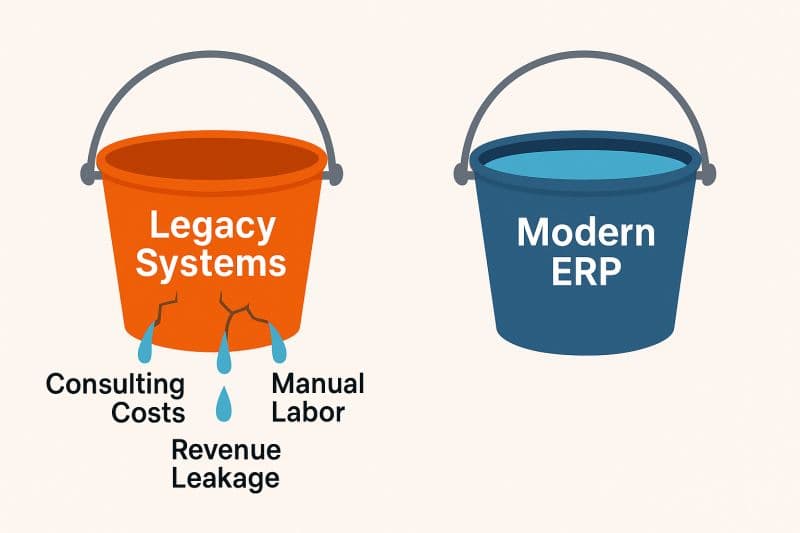
In a recent chat with a CFO, she described her monthly ritual this way: she opens the balance sheet, sees operating costs have crept up another two per cent, and has no real answer for why. The invoices reconcile, and the purchase orders match. Everything looks clean on paper, yet the margin keeps thinning.
That gap between what the numbers say and what the business feels is where cost leakage lives, and it rarely announces itself. Cost leakage rarely shows up as one dramatic failure. It builds through small, repeated cuts. A duplicate invoice here, a vendor that stopped delivering months ago but somehow still gets paid. A rebate clause buried on page forty of a contract nobody rereads after signing.
Individually these look like rounding errors. Added up across a year of enterprise transactions, they can quietly erase a meaningful slice of profit. Part of what makes leakage so hard to pin down is scale. A company running a single ERP instance across several business units might process hundreds of thousands of line items a month, spread across thousands of vendors, each with its own contract terms and payment history.
No finance team, however sharp, can hold that much detail in working memory. Spot checks catch the obvious cases. What they miss is everything subtle enough to survive a sample review, which, statistically, is most of it.
Why rule-based ERP controls miss so much
Most ERP systems were built to enforce rules, not judgment. They check that a purchase order number matches an invoice, that an approval was logged, that a total falls within a threshold.
This works fine when the person or vendor doing something wrong follows the obvious pattern. It falls apart the moment they don't. Change one digit on an invoice number, split a large purchase into three smaller ones under the approval limit, or route a payment through a slightly different vendor code, and a rule-based system waves it through.
It was never designed to ask whether something looks unusual for that vendor or that department. It was designed to check boxes. This is the real shift AI brings to ERP anomaly detection for finance.
Instead of matching fields, machine learning models learn a vendor's normal rhythm, typical invoice size, usual payment cadence, historical volume, and flag anything that breaks from it.
A first-time vendor suddenly billing at the pace of a decade-long supplier gets noticed. A department whose spend jumps sharply against its own history gets noticed. The system stops asking "does this follow the rule" and starts asking "does this fit the pattern," which is a very different and much harder question to dodge. I think the easiest way to picture this is a bank fraud alert. Your card gets flagged not because the purchase broke a written rule but because you don't usually buy furniture at three in the morning in another city.
Nobody programmed that specific scenario into the system. The model simply knows your spending shape and something didn't match it.
Enterprise procurement works the same way once you give a model enough history to learn from, only the stakes tend to run into six or seven figures rather than the price of a sofa.
The big three blind spots hiding in enterprise ledgers
Three problems tend to account for most of the leakage I have seen discussed by finance teams working through this kind of audit. Duplicate and split invoicing sits at the top of the list. Vendors, sometimes by accident and sometimes not, submit the same invoice twice under slightly different reference numbers, or break one large bill into pieces that each fall under the approval threshold.
A basic keyword match won't catch a description that has been reworded slightly. Semantic matching, which compares the meaning of invoice line items rather than their exact text, catches these near duplicates because it recognizes that "consulting services, March" and "professional services rendered, month of March" are describing the same charge. Ghost vendors are the second blind spot, and arguably the most expensive one. These are supplier profiles that stay active in the ERP long after the vendor has merged, closed, or simply stopped delivering anything of value, yet payments keep flowing.
Network analysis, which maps relationships between vendor records, bank details, and approval chains, can surface these because it looks at the whole web of connections rather than one transaction at a time. A vendor with a bank account shared across three "different" supplier profiles, or one with no delivery activity for eighteen months but a live payment schedule, stands out once you're looking at the network instead of the invoice. Uncollected rebates round out the trio, and they're easy to miss because nothing about them looks wrong. The company simply isn't claiming money it's actually owed. Large vendor contracts often include volume discounts, rebate tiers, and early payment incentives that shift as purchasing volume grows.
Tracking those clauses against real transaction history by hand is tedious enough that it rarely gets done consistently. An AI system built to read contract terms alongside live purchasing data can flag when a company has crossed a rebate threshold and isn't collecting what the agreement promises.
Auditing without breaking anything
Every finance leader I have heard discuss this raises the same concern before any of the upside. Nobody wants a new tool touching the general ledger. The fear of a software layer corrupting historical records or interfering with live transaction processing is enough to stall a project before it starts, and honestly, that caution is fair. The answer is architectural, not aspirational, because a well-built AI auditing layer sits outside the core ERP and reads event logs, transaction histories, and vendor records in a strictly read-only capacity.
It doesn't write back to the ledger, doesn't alter approval workflows, and doesn't touch the accounting core at all. Think of it as an independent set of eyes working continuously in the background, comparing what it sees against learned patterns, and surfacing anomalies for a human to review. The books stay exactly as they were. Only the visibility changes. This separation matters for security as much as for peace of mind. Because the AI layer has no write access to financial records, the attack surface for anything going wrong stays contained. IT and finance teams can approve this kind of deployment without opening a door into systems that need to remain locked down.
From catching losses to stopping them
Here's where the real payoff shows up. A standard after-the-fact audit is forensic by nature. It happens weeks or months after the money has already left the building, and by the time anyone spots the pattern, recovery is often impossible or barely worth the legal cost of pursuing it. Automated spend leakage detection changes the timing of the whole exercise. Once a model has learned what normal looks like for a given vendor or department, it can score transactions before payment authorization rather than after the fact.
A duplicate invoice gets held for review before the second payment goes out, not flagged three months later during a reconciliation. A ghost vendor gets frozen before another payment cycle runs, not discovered during an annual audit.
That change, from reviewing history to intercepting anomalies in real time, is what turns an ERP from a passive record keeper into something closer to an active financial safeguard.
What ROI Actually Looks Like
When CFOs evaluate AI for financial auditing within an ERP ecosystem, they naturally want a straightforward answer on payback timelines. The reality is that ROI depends on transaction volume and data hygiene.
For a mid-sized enterprise processing tens of thousands of monthly invoices, initial anomaly flags such as duplicate invoices and inactive vendor profiles typically surface within thirty to sixty days as the system learns historical patterns. Meanwhile, recovering uncollected rebates often spans a full contract cycle, aligning with annual triggers. Yet, the true financial impact becomes clear long before major vendor renegotiations begin. Catching duplicate invoices before payment rather than scrambling to recover funds afterwards frequently covers a meaningful share of deployment costs within the first two quarters. Achieving this requires honest expectations. Transforming financial oversight isn't a magic switch that eliminates waste overnight; the model requires clean historical data and an initial calibration window where a few false positives are naturally surfaced. Teams that plan for this calibration period extract vastly more compounding value from the rollout.
Zero Migration, Absolute Vigilance
The best part? None of this requires a risky, multi-million-dollar ERP overhaul or a disruptive migration. At OptimusAI Labs, our solution, IntelliCore, turns your existing ERP into an Intelligent System without rebuilding. By layering directly on top of your current architecture, IntelliCore leaves your core ledger completely untouched. The ledger remains the system you’ve always trusted, but with a transformative upgrade: for the first time, an intelligent layer is watching it closely enough to catch the critical details that even the most diligent human reviewer simply doesn't have the time to find. Stop leaving capital hidden in your vendor data. With IntelliCore, OptimusAI Labs delivers enterprise cost optimization that respects your existing infrastructure, prevents expense leakage, and pays for itself long before day one.